

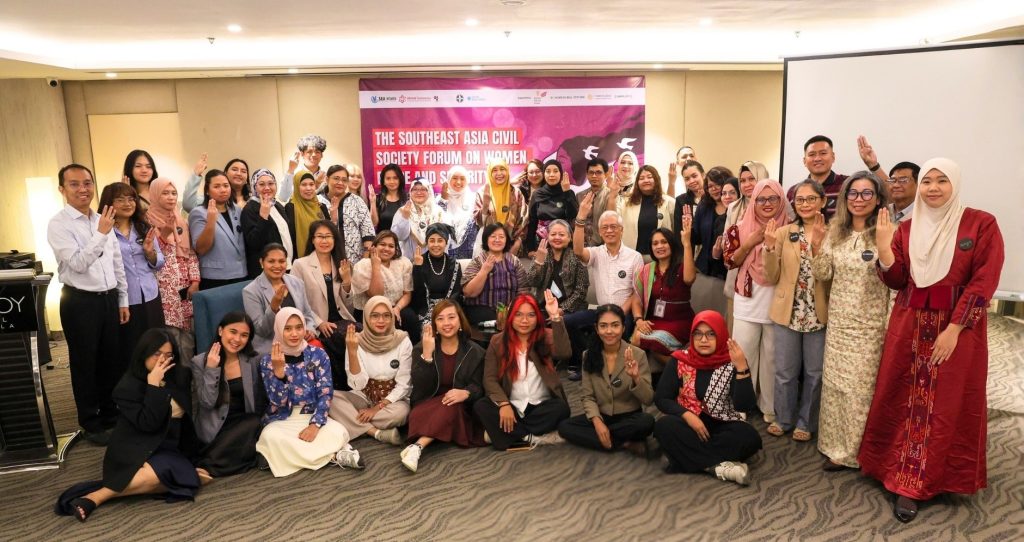
Manila, Philippines — Fifty representatives of civil society organizations, women peacebuilders, journalists, and women human rights defenders from Southeast Asian countries gathered for the Southeast Asia Civil Society Forum on Women, Peace and Security on 4–5 October 2026 at Savoy Hotel Manila, Philippines. The forum called for stronger implementation of the Women, Peace and Security (WPS) agenda so women’s participation translates into genuine decision-making influence, access to resources, rights, and justice.
Under the theme “Reclaiming the Political Agenda of WPS: Power, Civic Space, and Women’s Leadership in Times of Democratic Backsliding,” the forum was jointly organized by the Southeast Asia Women Peacebuilders (SEAWP), The Asian Muslim Action Network (AMAN) Indonesia, Thammasat University, the Philippine Center for Islam and Democracy (PCID), and IMAN Research. Participants came from ASEAN member states: the Philippines, Indonesia, Malaysia, Timor-Leste, Brunei Darussalam, Thailand, Cambodia, and Myanmar.
Held ahead of the ASEAN Conference on Women, Peace and Security on 6–8 October 2026 in Manila, the forum is supported by Mensen met een missie, Heinrich Boll Stiftung, Colmena Fund, and Amplify Project by The Asia Foundation, this forum consolidated civil society knowledge and priorities through plenary panels, exchanges of country experiences, thematic discussions, and collective recommendations to strengthen national and ASEAN WPS implementation.
From Presence to Recognition: Women Peacebuilders Contributing in the Implementation of the Regional Action Plan on WPS
The forum acknowledged progress in institutionalizing WPS across Southeast Asia while highlighting gaps between policy commitments and women’s experiences in their communities. Action plans have not consistently delivered sustainable funding, institutional coordination, adequate protection, or women’s authority to shape peace and security policies.
“The Women, Peace and Security (WPS) agenda in ASEAN has advanced through National and Regional Action Plans, but policy progress has yet to fully translate into tangible security and women’s influence in decision-making. Amid democratic backsliding, militarization, and shrinking civic space, women peacebuilders need access to power, resources, and the freedom to shape the agenda. ASEAN must therefore institutionalize sustained and meaningful engagement with civil society and grassroots women, ensuring that their knowledge and experiences shape peace and security policies,” explained Ruby Kholifah, one of SEAWP’s members and Country Representative of AMAN Indonesia.
Furthermore, Suyen Barahona, President and CEO of Colmena Fund addresses that “Women peacebuilders and civil society across Southeast Asia continue to mediate conflicts, support communities, and defend civic space in difficult circumstances. Their work deserves recognition, resources, and the power to influence decisions. Their leadership and cross-border solidarity are vital to advancing WPS implementation and building just and sustainable peace.”
I Gusti Agung Wesaka Puja, Executive Director of ASEAN Institute for Peace and Reconciliation (ASEAN IPR) on his welcoming remarks also highlights the civil society forums on Women, Peace and Security (WPS) providing an important space to connect the experiences, knowledge, and recommendations of community women peacebuilders with national and regional policies. Through dialogue, partnership, and sustained engagement, these forums can advance WPS implementation in ASEAN by grounding it in local realities and priorities. Amid shrinking civic space and declining financial support, women and civil society need the space, resources, recognition, and influence to shape peace and security decisions across the region.
WPS in ASEAN: Assessing Implementation in a Changing Democratic Landscape
The first plenary session, “WPS in ASEAN: Assessing Implementation in a Changing Democratic Landscape”, brought together representatives from the Philippines, Indonesia, Thailand, Malaysia, and Timor-Leste to examine the gap between WPS policy commitments and implementation. The presentations showed that adopting action plans does not automatically ensure women’s influence in decision-making, while limited funding, institutional support, and coordination continue to hinder progress at the community level.
Salma Pir T. Rasul from PCID highlighted advances in the Philippines through WPS localization in Bangsamoro, institutional development, and a WPS diploma program, alongside persistent constraints in political will, practitioners’ understanding, and local organizations’ access to funding.
Fina Nihayatul Mazziyyah from AMAN Indonesia highlighted stronger civil society networks and WPS localization in Indonesia, emphasizing the need to expand the next-generation action plan’s focus on human security. Her presentation also identified regional disparities, institutional fragmentation, militarized security approaches, intimidation and digital violence against women peacebuilders and human rights defenders, and unfinished transitional justice as significant concerns.
Nurhuda Ramli from IMAN Research discussed civil society organizing through Malaysia’s Hibiscus coalition and regional learning, while highlighting the tension between expanding WPS to address non-traditional security threats and implementation that remains anchored in the defence and security sectors.
Fatin Jamjure from The Network of Civic Women for Peace emphasized women’s involvement in decision-making, monitoring, and evaluation in Thailand, where limited understanding of the WPS action plan, online harassment, and political changes challenge policy continuity.
Judith Maria de Sousa from Ba Futuru shared Timor-Leste’s experience of government–civil society cooperation in implementation, capacity strengthening, and joint advocacy.
The exchanges underscored that action plans are a starting point, with WPS success ultimately measured by improvements in women’s safety, human security, freedom of religion or belief, access to justice, and influence over decisions. Connecting policy with women’s experiences requires stronger civil society networks, local capacity, sustainable funding, and recognized authority for women in decision-making. Participatory monitoring and accountability mechanisms are also essential to assess tangible outcomes and ensure that WPS implementation responds to community needs amid political changes and shrinking civic space across the region.
Addressing Interconnected Threats
After the first plenary session, there are thematic discussions exploring connections between WPS and the climate crisis, community resilience, technology-facilitated gender-based violence, humanitarian responses, faith, young women’s leadership, reintegration, and transitional justice.
Participants highlighted shrinking civic space through intimidation, surveillance, criminalization, censorship, and violence against women peacebuilders. Digital threats include doxxing, disinformation, AI-generated sexualized abuse, and coordinated harassment that can silence women and cause real-world harm.
The forum called for legal protection, digital security, safe evidence handling, psychosocial support, and platform accountability. Women must also participate meaningfully in digital policymaking.
Discussions on faith highlighted the Indonesian Women Ulama Congress (KUPI), which strengthens women’s religious authority by grounding interpretation in women’s experiences, justice, and protection from harm. Reflective Structured Dialogue (RSD) was also discussed as an approach to building trust, reconciliation, and reintegration through personal experiences and shared humanity.
The forum emphasized links between WPS and Youth, Peace and Security (YPS). Young women need safe spaces, organizational support, intergenerational learning, and opportunities to design policies and programs.
Myanmar and the Cambodia–Thailand Border
On the second day, a special session addressed Myanmar’s crisis and the Cambodia–Thailand border conflict as regional security concerns. In Myanmar, armed conflict, displacement, forced conscription, sexual violence, trafficking, and digital surveillance compound communities’ vulnerabilities.
Women peacebuilders, journalists, and activists in exile also face barriers concerning legal status and mobility, alongside risks of arrest and deportation. The forum called for implementation of ASEAN’s Five-Point Consensus through measurable indicators, timelines, regular reviews, and engagement with women’s organizations, civil society, ethnic stakeholders, and democratic actors.
Along the Cambodia–Thailand border, participants highlighted livelihood losses, disrupted education, limited clean water, family separation, debt, and trauma. Recommendations included de-escalation, civilian protection, humanitarian access, sustained dialogue, and women’s involvement in recovery and cross-border peacebuilding. Humanitarian responses must move beyond emergency relief to address the underlying drivers of insecurity through a human security approach.
Recommendations for Shared Responsibility
The forum’s joint statement called for structured, sustained civil society engagement in implementing the ASEAN Regional Plan of Action on WPS, particularly through the ASEAN Committee on Women (ACW). Proposals included formal civil society representation in the WPS Advisory Group, multi-stakeholder reviews, and mechanisms for dialogue, feedback, and follow-up.
Grassroots women’s knowledge must be recognized as policy evidence. Monitoring should measure women’s safety, influence, access to justice, and resources, rather than activities alone. Civil society organizations were urged to strengthen regional solidarity, collective protection, leadership succession, documentation, and resource-sharing.
Governments were urged to provide regular public budgets, cross-sector coordination, protection for human rights defenders, and sustained, gender-responsive recovery and transitional justice. Reintegration must recognize women former combatants as actors in reconciliation, with access to livelihoods and socioeconomic support.
Donors were encouraged to provide long-term, flexible funding accessible to grassroots organizations, including informal and refugee-led groups.
Extending this shared responsibility to religious actors, Rick van der Woud from Mensen met een missie emphasized the importance of engaging religious leaders in advancing WPS implementation and strengthening advocacy from the local to the global level. He highlighted that religious interpretations also contribute to peacebuilding, underscoring religious leaders’ role in promoting interpretations that uphold women’s rights and support their meaningful participation and leadership in peace processes.
The forum affirmed that WPS’s future depends on women’s ability to shape decisions and experience tangible change: from presence to influence, from consultation to shared responsibility, and from written commitments to peace that communities can feel.