

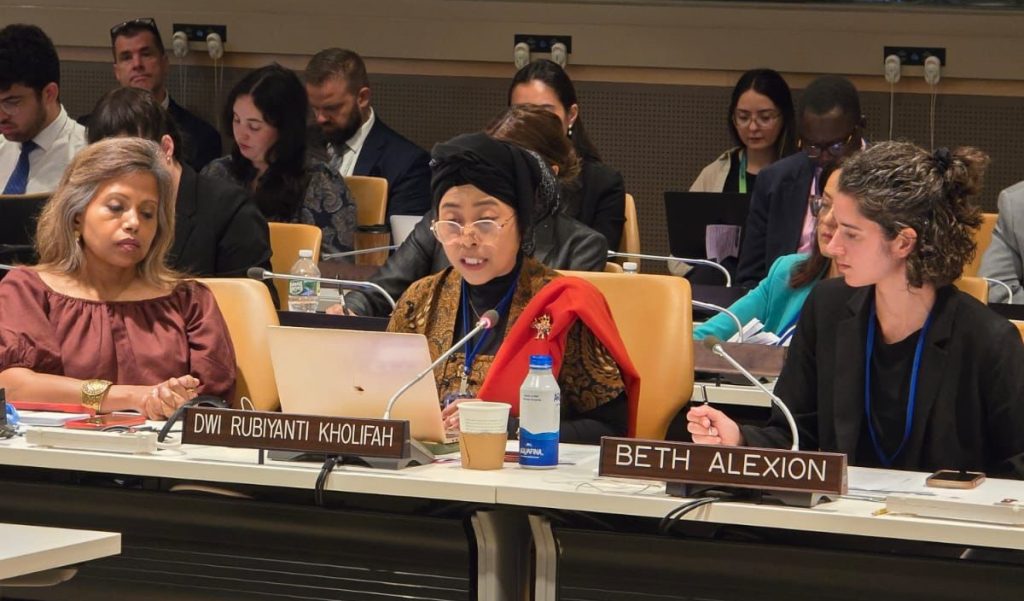
United Nations Headquater New York , 26th June 2026. Today, I had the privilege of speaking at the side event “Beyond Tokenism: Women Leading Prevention, Justice and Policy in Counter-Terrorism” during the 2026 United Nations Counter-Terrorism Week, organized by UNOCT, CTED, and UN Women in partnership with Canada, Switzerland, the European Union, Indonesia, Kenya, Mexico, Costa Rica, and the Global Civil Society Coalition on Human Rights and Counter-Terrorism.
The discussion centered on a critical question: How do we move beyond tokenistic participation and recognize women-led organizations as strategic partners in preventing violent extremism? Across many countries, women-led organizations are still invited to consultations, yet excluded from meaningful decision-making.
It was an honor to share the panel with Halimah Mohamed from Kenya and Ambika Satkunanathan from Sri Lanka.
I shared AMAN Indonesia’s experience in Sigi, where, together with Libu Perempuan, we built advocacy grounded in victims’ voices following the 2020 terrorist attack. I also presented our experience in establishing the Working Group on Women and PCVE (WGWC) as a collaborative governance platform. Through WGWC, we have supported the localization of Indonesia’s National Action Plan on Preventing Violent Extremism (RAN PE), consolidated grassroots knowledge, and contributed to establishing Thematic Working Groups (Pokja Tematis) as a formal mechanism for civil society participation. These efforts have helped make the participation of women-led organizations more meaningful—not merely symbolic.
Halimah shared Kenya’s experience, where women-led organizations support survivors of conflict-related sexual violence committed by Al-Shabaab while helping prevent violent extremism at the community level. Yet despite working on the frontlines, many women-led organizations continue to face severe resource constraints and struggle to secure sustainable funding.
Ambika concluded with a powerful reminder that as discussions on the Global Counter-Terrorism Strategy evolve, we must not lose the language of gender equality or diminish the role of civil society. Otherwise, counter-terrorism risks becoming increasingly securitized while overlooking the social conditions that enable sustainable peace.
Today’s discussion reaffirmed one important lesson:
Moving beyond tokenism means recognizing women-led organizations not simply as participants, but as strategic governance partners that connect communities, public institutions, and policy to build more effective, inclusive, and sustainable approaches to preventing violent extremism.
By Dwi Rubiyanti Kholifah